
Blog

What Is a Utility Bill? Types, Costs and What’s Included
A utility bill is a periodic invoice from a utility provider for essential services like electricity, natural gas, water, and
Generate, Customize, and Download Utility Bills
A utility bill template is a pre-formatted document that replicates the structure of an official utility bill for electricity, water, or gas. These editable files come in PDF, Word, Excel, and Google Docs formats. People use them for proof of address submissions, expense tracking, and record-keeping.
An official bill is issued by a licensed provider and carries legal standing. A template uses user-entered data instead of provider-validated records. It mirrors real bill structure but doesn’t carry provider authority.
| Feature | Official Utility Bill | Utility Bill Template |
|---|---|---|
| Issued by | Licensed utility provider | Individual or third-party tool |
| Data validation | Provider-verified | User-entered |
| Legal standing | Binding financial record | Non-binding document |
| Editability | Fixed structure | Fully customizable |
| Accepted for KYC | Yes, if criteria met | Depends on source and accuracy |
Several user groups rely on utility bill templates for legitimate purposes:
The U.S. Energy Information Administration reported an average monthly residential electricity bill of approximately $137 in 2024, which shows the financial scale accurate billing templates need to reflect.
Choose the location that applies to you.
Fill in your details to personalize your file.
Pay securely to unlock your document.
Get your ready-to-use file instantly.
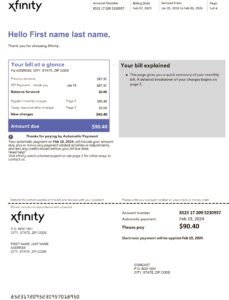
A complete template needs four core areas: provider and account information, billing period and dates, charges and usage breakdown, and payment details. Missing any of these, especially the billing address or payment options, is the most common reason a document gets rejected.
The header must include the utility company’s legal name, a company logo placeholder, service type, account number, and full contact details. Don’t skip the account number. It’s one of the most frequently omitted fields, and its absence signals the document isn’t a genuine billing statement. A format like ACC-2025-00847 follows standard provider conventions.
Show explicit start and end dates, for example “01/01/2026 to 31/01/2026.” This is a documented compliance requirement. Under AUSTRAC’s Customer Identification Procedures, utility bills submitted for proof of address must be dated within the last 90 days. Most banks apply a stricter 60-day window.
| Line Item | Example Value |
|---|---|
| Previous meter reading | 14,320 kWh |
| Current meter reading | 15,223 kWh |
| Units consumed | 903 kWh |
| Rate per kWh | $0.1805 |
| Energy charge | $163.00 |
| Fixed service fee | $12.50 |
| Taxes and surcharges | $9.80 |
| Total amount due | $185.30 |
Avoid round totals like exactly $200.00. Realistic figures with cents reflect actual rate calculations and improve document credibility. Tier usage, where applicable, affects the total by applying different rates across consumption bands.
List accepted payment options: online portal, check or money order, automatic bank draft, and in-person locations. Include the customer service phone number and mailing address. These details appear on every real utility bill. Their absence makes a template look incomplete.
Beyond the standard header, an electricity template needs: meter number, previous and current readings, units consumed in kWh (current reading minus previous reading), rate schedule or tariff code, tier levels where tiered pricing applies, electricity tax, VAT, meter rental charge, and an environmental disclosure aligned with applicable regulations such as CNMC Circular 2/2021 for Spanish markets.
The EIA reports average monthly consumption of around 843 kWh at roughly 18.83 cents per kWh. Using figures in this range makes your electricity template look professionally prepared.
Water templates use gallons or cubic meters. Key fields: previous and current meter readings, fixed service quota based on pipe diameter, variable consumption quota, sewer and wastewater charge as a separate line item, and tier pricing levels if applicable. The EPA reports typical household use exceeds 300 gallons per day, roughly 10,000 gallons monthly for a family of four.
Gas templates require: meter number and readings, units in therms or CCF, gas rate per unit, supply period dates, fixed supply charge, and distribution fees. Therms are standard in the U.S.; cubic meters are common in Europe.
Multi-utility templates list electricity, water, and gas as separate sections on one statement, each with its own meter readings and subtotal. Internet and telephone templates use subscription-based formatting. Trash and recycling templates are the simplest, with a flat service fee and collection schedule.
Isn’t it frustrating when a carefully prepared document gets rejected over a missing detail? Institutions including banks, government agencies, landlords, and universities apply consistent criteria:
The Reserve Bank of India’s KYC Master Direction specifies a two-month window. Australian AML/CTF regulations allow 90 days. Digital PDF copies downloaded from provider portals are accepted by most modern institutions, provided they display all required fields. A visible company logo on the document also strengthens acceptance, since institutions look for recognizable provider branding.
Landlords use templates to split shared utility costs across tenants. A structured template documents the billing period, individual consumption allocation, and total charge per unit. Disputes drop when the numbers are clearly laid out. Small businesses use templates for monthly accounting reconciliations and tax documentation.
Finance trainers and HR onboarding teams use mock templates for practical exercises. Students practice reading and verifying billing statements without using real account data. Templates also help individuals estimate expected monthly utility costs before moving to a new property.
We’ll provide another for free.
Each bill is professionally designed and AI-verified for accuracy.
Receive your file within 24 hours, guaranteed.
We use trusted and legal payment methods, offering you a smooth and safe transaction.
Our support team consists of real people, ready to assist. While orders are available 24/7, support responds as quickly as possible.
Your personal details are deleted after your order, ensuring complete confidentiality.
PDF preserves formatting across all devices, so names, addresses, and billing amounts appear exactly as entered. Fillable PDFs from platforms like pdfFiller or FormsPal include all required fields in a format accepted by most institutions. A finalized PDF also prevents unauthorized alterations, which supports document integrity during official review. The editable features are locked once you export, making it the right choice for submissions.
Word is the most practical format for editing. It supports text entry, table formatting for the charges section, logo insertion, and direct export to PDF. Keep a master template file and copy it for each new use. Word’s table tools handle the charges breakdown section cleanly, which is one of the most common formatting failures in independently created templates.
Google Docs is free with any Google account and works from any device. To use a shared template, go to File, then Make a copy. That creates your own editable version without changing the original. Download as PDF or Word directly from the File menu. It offers slightly less precise table formatting than Word, but it’s a solid option when you don’t have Microsoft Office installed.
Many platforms require paid subscriptions for editable files or provide flat images that can’t be modified. Here are genuinely accessible options:
| Platform | Format Available | Account Required | Notes |
|---|---|---|---|
| Template.net | PDF, Word, Google Docs | Yes (free tier) | Large library across multiple utility types |
| Jotform | PDF, online form | Yes (free tier) | Generates filled PDF output directly |
| brand-utilitybill.com | PDF, editable | No | UK and international formats |
| DocHub | Yes (free tier) | Electricity, gas, water forms | |
| pdfFiller | Yes (free tier) | Generates complete bills from entered data | |
| Google Docs Template Gallery | Google Docs | Google account | Download as PDF or Word after editing |
Template.net offers downloadable and browser-editable files across multiple utility types. Jotform’s form builder lets you generate a filled PDF output directly, which is practical for one-time submissions. Before downloading from any platform, confirm the file contains editable fields rather than a flat image, and check that account number, billing period, meter readings, charges breakdown, and payment details are all present.
Yes, if it meets institutional requirements: the account holder’s full legal name, complete physical address, a billing date within the last 60 to 90 days, and clearly identified provider details. Incomplete or generic templates are routinely rejected. Accuracy and professional formatting aren’t optional here.
Word is the most practical for editing. It supports text entry, table formatting, logo insertion, and direct PDF export. Google Docs is the best option when you don’t have Microsoft Office. PDF is best reserved for final submission rather than editing.
Most banks and government agencies require a bill dated within the last 60 to 90 days. RBI guidelines specify 60 days. Australian AML/CTF regulations allow 90 days. Bills older than three months are treated as expired for KYC purposes, even if the account is still active.
Creating a template for record-keeping, tenant billing, budgeting, or training is legal. Using one to misrepresent identity or fabricate financial records constitutes fraud and carries serious legal consequences. The template is a neutral document tool. Its legality depends entirely on how it’s used.
Yes. Google Docs is free with any Google account and requires no software installation. Build a template from scratch using tables and text formatting, or duplicate a shared template via File, then Make a copy. Download the completed document as PDF or Word directly from the File menu.
A utility bill is a periodic invoice from a utility provider for essential services like electricity, natural gas, water, and